
Information on the 1 April 2026 price increase
We have sent out a letter to our customers on the price increase that comes into force on 1 April 2026.
The letters will be delivered by post, email, Kivra or OmaPosti, depending on the channels the customer has in use.
See the FAQ below for more information.
What is the reason for the price increase?
The reasons for the price increase have been the same for the past couple of years. We are raising prices primarily because the need for investment in the distribution network has grown in recent years. The pressure to develop the network is significant, which unfortunately means that the prices paid by customers must be raised.
In addition, the national and regional network fees that increased at the turn of the year also cause and upward pressure. These account for approximately one third of the increase. The previous time these fees were raised was at the start of 2025.
Electricity distribution fees cannot be raised indefinitely, as there is an eight-per-cent annual cap on the average increase. In Finland, this is monitored by the Energy Authority. For this reason, it may, however, feel like prices are being gradually nudged upwards.
How have the prices developed in recent years?
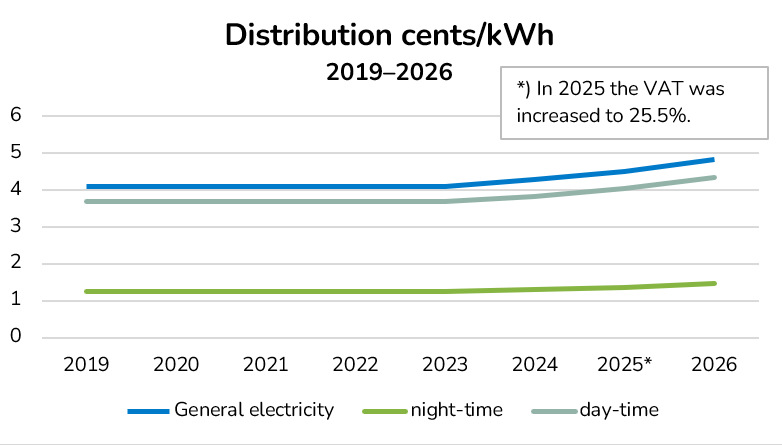
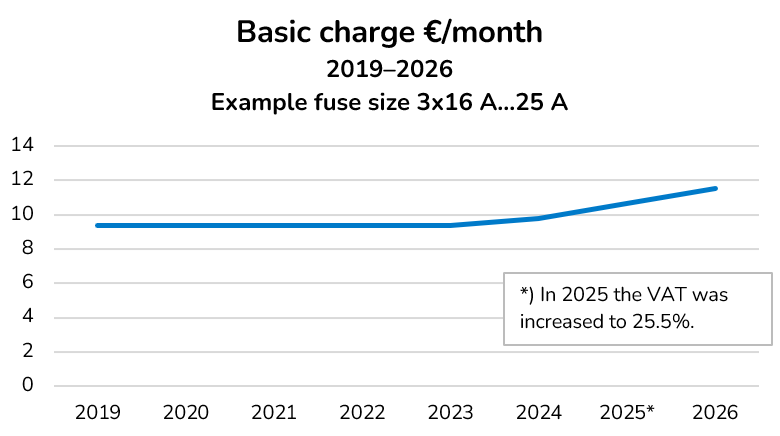
2024 was the first year when the prices were increased after a long pause. The prices were also increased in 2025 and 2026. The amount of the increase has varied between different distribution products.
The figures below show the development of distribution prices according to the most common metering methods and the development of the fixed basic charge for a typical fuse size in a detached house.
Who pays for Vaasan Sähköverkko’s investments?
Like other network companies in Finland, Vaasan Sähköverkko’s revenues come from electricity distribution service charges. These revenues cover all investments. In the past five years, Vaasan Sähköverkko has invested over 70 million euros in the region’s distribution network.
When will the change appear on the bill?
The change will affect electricity consumption starting from April, so depending on the billing cycle, as early as May.
How much will the price go up?
The increase varies depending on the electricity distribution product. Here you can compare current and future prices.
The average increase for customers is approximately 5.9% per month, including VAT and electricity tax.
For typical consumer sites, the average increases are:
- Flat in an apartment building (2,500 kWh/year): €1.53/month
- Detached house without electric heating (5,000 kWh/year): €2.21/month
- Detached house with electric heating (19,000 kWh/year): €4.95/month
It is important to note that these are average effects on the price. For example, electricity consumption in an apartment can be significantly lower than 2,500 kWh per year, in which case the price impact is correspondingly smaller.
For business customers, low voltage product prices will rise on average by 7.5% and medium voltage products by an average of 4.5%. These percentages do not include VAT or electricity tax.
How can I influence the size of the network service charge myself?
You can directly influence the size of the service charge primarily by changing your electricity consumption.
In winter, the most significant electricity saving measure, especially in electrically heated detached houses, is to ensure that the indoor temperature is not unnecessarily high. Even a one-degree reduction has a major impact.
Flats in apartment buildings are often heated with district heating, but in many flats, the bathroom underfloor heating operates with electricity. If your flat has this, make sure you cannot feel the heat through your socks. This type of underfloor heating is often a big electricity guzzler. Its purpose is to dry structures, not to heat the floor. Also, keep the bathroom door closed if the underfloor heating is on; otherwise, the heat escapes into the flat and wastes electricity unnecessarily.
When it comes to electricity distribution, it may also be wise to check that the most suitable metering method is in use for your property (e.g. general electricity/night-rate electricity). The metering method can be changed once a year, and the change is free of charge.
What is the difference between the network service charge and the price of electricity?
When you consume electricity, you pay for both its distribution (network service charge) and the energy you use. Your local electricity distribution company charges for distribution as a network service charge. This includes the energy distribution price (c/kWh), basic charge (€/month), VAT (25.5%), and electricity tax (for consumers about 2.25 c/kWh, with VAT about 2.83 c/kWh).
In addition, the electricity supplier you choose charges for the energy you consume according to their price list. Depending on the contract type, this often includes an energy price (c/kWh) and a basic charge (€/month). These also include VAT (25.5%).
Does the increase also apply to maintenance fees?
Yes, the increase also applies to maintenance fees. See the new maintenance prices at the bottom of this page.
Can the price of electricity distribution be raised without limit?
No, it cannot. An electricity distribution company can increase prices by an average and maximum of 8% per year. This is monitored in Finland by the Energy Authority which also sets the limit for the maximum reasonable return that a distribution company can collect.
These current limits are challenging for network companies, as capping returns makes it difficult to make necessary investments. Because returns and price increases are restricted, this causes a fluctuation in pricing. Prices must be nudged up little by little.
From the customer’s perspective, this means continuous price increases and from the distribution company’s perspective, insufficient returns for investment needs. At the same time, price moderation is an important value for us, which we consider every time we decide to raise prices.
Also read the question about investments.
Will my invoice frequency change?
We are changing the frequency of invoicing for customers who have received their invoice four times a year. From now on, you will get your invoice six times a year, or every second month. It will not cause you additional costs. With the change we are harmonizing our billing practices.